
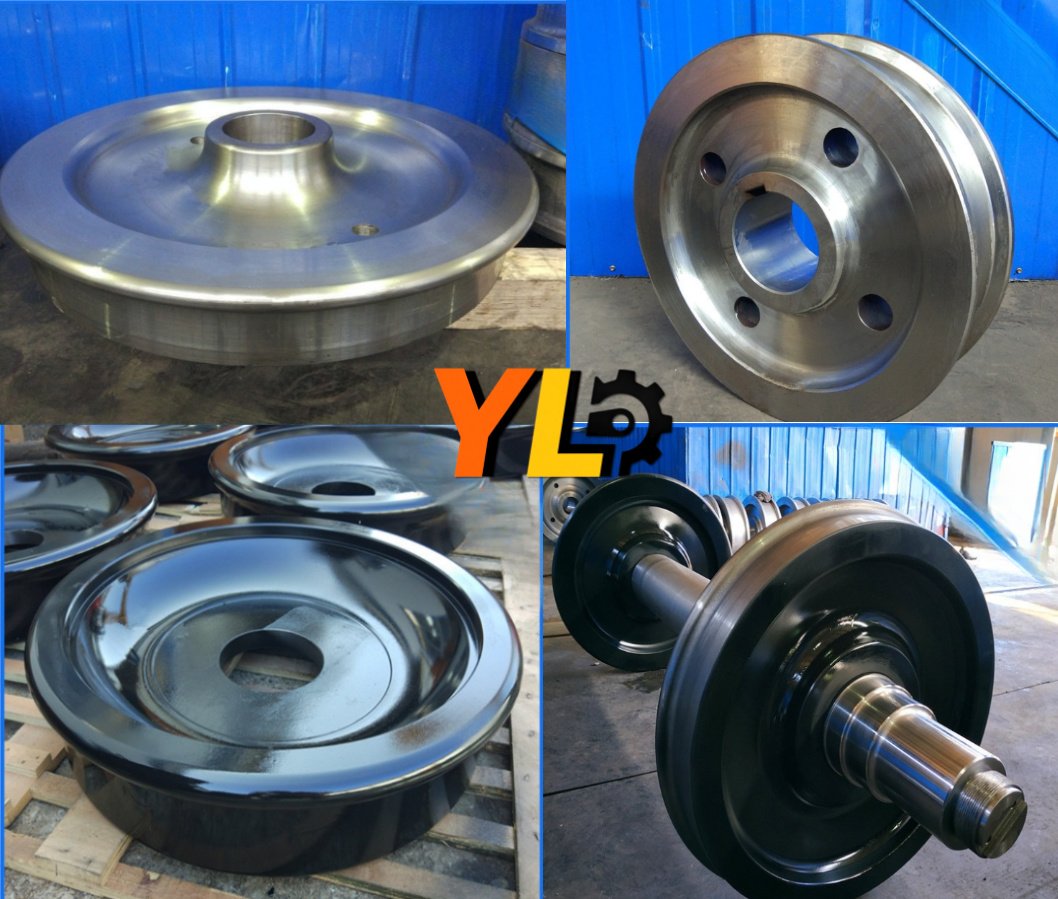
Mining cast wheels are the main bearing parts of mining vehicles (e.g. , mining trucks, load-haul-dump machines and dump trucks), which have a direct impact on the operating safety, efficiency and service life of the vehicles. Due to the severe mining environment (heavy load, dust, high and low temperature, possible corrosive media, etc.), their choice should be comprehensively considered with many factors such as working condition, material, construction, performance, etc. Here’s a step-by-step guide:
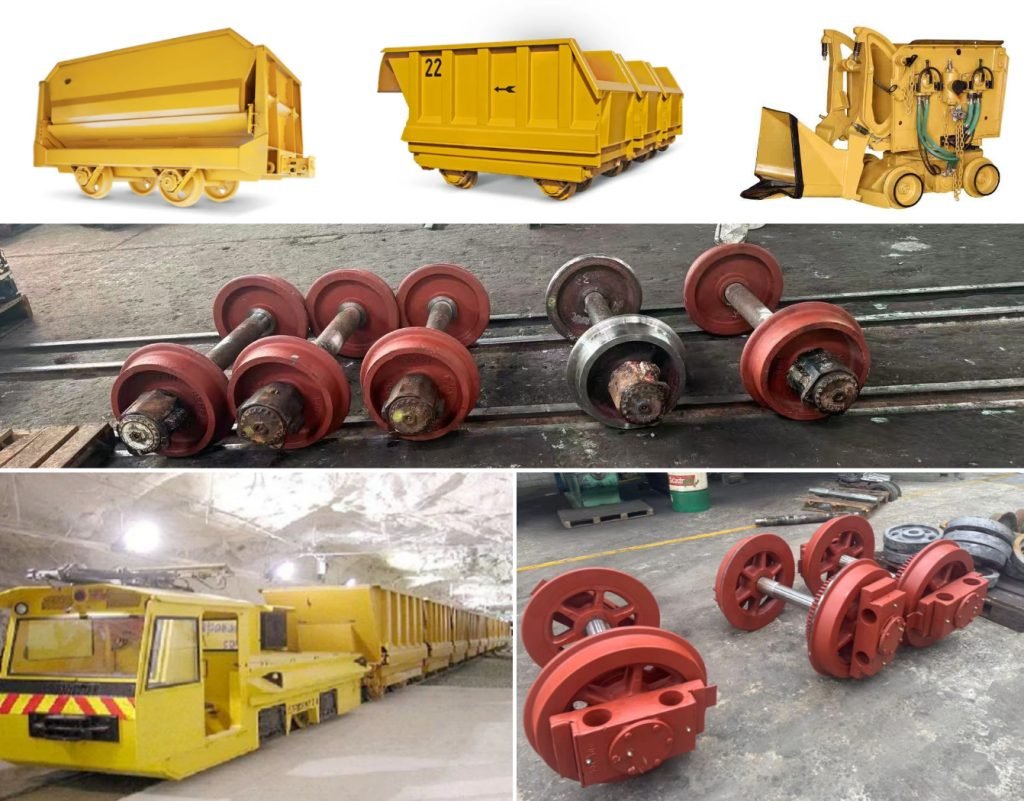
I. Clarify Operating Conditions: The Core Premise
Differences in mining scenarios directly determine the performance requirements of wheels. It is necessary to first clarify the following key information:
- Mine Type
- Open-pit mines: The road surface is usually gravel and soil with significant impact loads. They are also impacted by natural surroundings (rain, snow, extreme temperatures, etc.). The wheels should be highly resistant to impact and wear.
- Underground mines: enclosed space, a lot of dust, possible water collection, possible minor corrosion (e.g. slag seepage) Wheels require both sealing performance (to minimize dust entering bearings) and corrosion resistance. Meanwhile, their size should be adequate for tiny openings.
- Vehicle Parameters
- Match the rated load capacity of the vehicle The wheels must have a load-bearing capacity > the whole weight of the vehicle (including goods) to prevent overload fracture.
- Tire specifications: The size of the wheel rim should be consistent with the tire (such as diameter, width, and bead seat angle), otherwise it will cause the tire installation to be unstable or abnormal wear.
- Installation dimensions: The number of rim bolt holes, hole diameter, pitch circle diameter (PCD) and center hole diameter must match the vehicle axle head for a secure installation.
- Road Conditions
- Hard road surfaces (cement, compacted gravel, etc.): The primary wear factor is rolling friction, thus you need to monitor the surface wear resistance of the wheels.
- Soft road surfaces (soil, slag): Vehicles are subject to bumps, with significant impact loads. Wheels must have great toughness (resistance to breakage).
- Special road surfaces (e.g. containing sharp ores): The edge of the wheel rim must be scratch-resistant so that it is not deformed by being sliced by the ores.
II. Focus on Core Materials: Determining Basic Performance
The material of cast wheels directly affects their strength, toughness, and wear resistance. Cast steel and ductile iron are commonly used in mining scenarios, with the following differences:
| Material | Performance Characteristics | Applicable Scenarios | Advantages and Disadvantages Comparison |
|---|---|---|---|
| Cast steel (e.g., ZG35CrMo) | High tensile strength (≥800MPa), good toughness, strong impact resistance, and excellent high-temperature stability. | Heavy-load (≥50 tons) and high-impact scenarios (such as dump trucks in open-pit mines). | Advantages: Top load-bearing and impact resistance. Disadvantages: Relatively heavy, high cost, and slightly lower wear resistance than ductile iron. |
| Ductile iron (e.g., QT500-7) | High strength (tensile strength ≥500MPa), good wear resistance (graphite structure plays a lubricating role), and moderate cost. | Medium-load (20-50 tons) and relatively smooth road scenarios (such as load-haul-dump machines in underground mines). | Advantages: Wear-resistant, lightweight (10%-15% lighter than cast steel of the same specification), and low cost. Disadvantages: Slightly weaker impact resistance than cast steel and prone to embrittlement at low temperatures. |
Selection Principles:
- For heavy loads (≥80 tons) and high-impact scenarios (such as transportation after blasting in open-pit mines), cast steel is preferred.
- For medium loads and scenarios where wear is the main issue (such as fixed-route transportation), ductile iron is preferred.
- For low-temperature environments (such as open-pit mines in northern China in winter), ordinary ductile iron should be avoided, and low-temperature tough cast steel (such as ZG270-500) can be selected.
III. Check Structural Design: Affecting Reliability and Adaptability
The structural design of cast wheels must balance “reasonable load-bearing” and “adaptability to working conditions”. Focus on the following:
- Spoke Structure
- Solid spokes : High load bearing and deformation resistance , but heavy and poor heat dissipation ( ideal for low speed and heavy load ) .
- Spoked spokes (with ventilation holes): Lightweight, good heat dissipation (reducing heat conduction during braking), slightly weak in impact resistance (ideal for medium-speed scenarios that require heat dissipation, such as long downhill transportation).
- Note: The joint between spoke and rim must be a fillet joint (to reduce stress concentration), otherwise it is easy to fracture in bumpy conditions.
- Rim Edge
- Edge thickness: For mining application it should be ≥12mm (approximately 8mm for normal vehicle) to avoid deformation due to impact with sharp ores.
- Bead seat: must be finely finished (<=Ra12.5) so as not to scratch the tire bead (which causes air loss).
- Sealing and Protection
- In case of large dust or water accumulation (e.g. deep mines) rims with dust-proof grooves or sealing rings should be selected so as to minimize the entry of dust and water in the space between the wheel and the axle head (to prevent wear of the bearing).
IV. Confirm Performance Indicators: Verify Reliability with Data
Check key performance indicators through test reports provided by manufacturers or industry standards:
- Load-Bearing Capacity
- Refer to the “rated dynamic load” (the maximum load the wheel can bear in a rolling state), which must be ≥ the single-wheel load when the vehicle is fully loaded (total vehicle weight ÷ number of wheels).
- It must pass the “static load test” (loading 1.5 times the rated load with no permanent deformation for 30 minutes).
- Impact Resistance
- Pass the “impact test” (simulate bumps and impact stress on the rim edge) without cracks or fractures.
- The impact absorption energy of cast steel wheels (-20℃) should be ≥27J, and that of ductile iron wheels (at room temperature) should be ≥15J (to avoid brittle fracture at low temperatures).
- Wear Resistance
- See “hardness index”: Cast steel wheel hardness should be ≥HB200; ductile iron wheel hardness should be ≥HB180 (the higher the hardness, the better the wear resistance, but toughness needs to be balanced to avoid brittleness caused by excessive hardness).
- In practice, one may notice the wear rate of the rim (the service life of high-quality wheels should be 30% longer than ordinary products in the same operating conditions).
- Casting Quality
- There should be no pores, sand holes, or shrinkage cavities on the surface (these defects will cause stress concentration and easily lead to fractures).
- There should be no internal cracks (detected by ultrasonic flaw detection).