
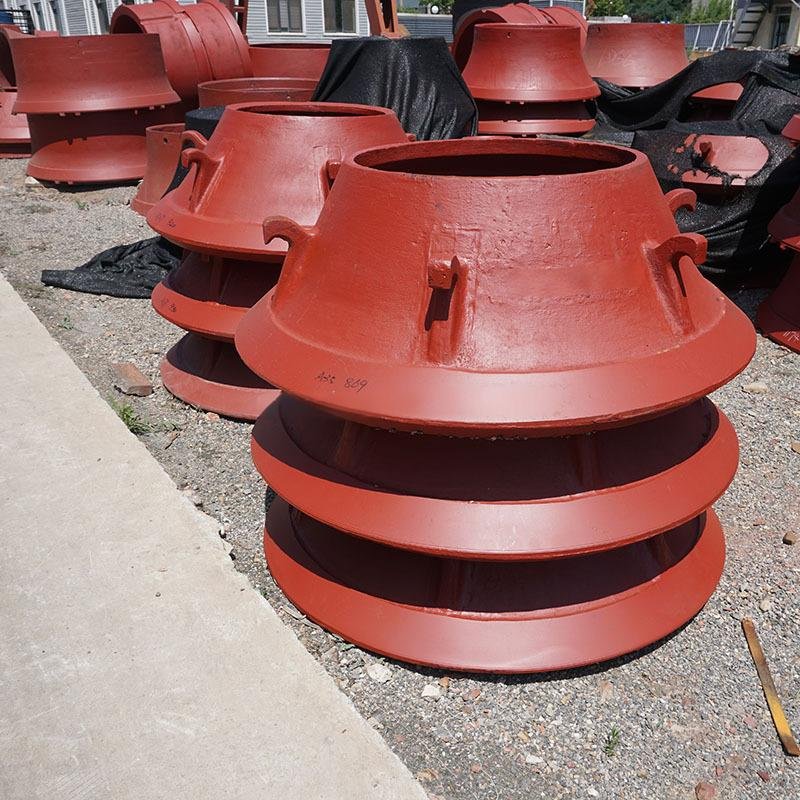
Cone crusher wear parts (primarily mantles, bowl liners, and bushings) require materials that balance abrasion resistance, impact toughness, and durability to withstand extreme crushing forces. The choice of material depends on the application (e.g., hard rock vs. soft ore), crushing intensity, and desired service life. Here are the most common materials, along with their properties and use cases:
1. High Manganese Steel (Hadfield Steel)
The most widely used material for mantles and bowl liners, especially in general-purpose crushing.
- Alloys: Mn13, Mn18 (13–18% manganese content, plus ~1.0% carbon).
- Key Property: Work hardening—the material softens under low impact but hardens dramatically (up to 500–600 BHN) when struck by hard materials (e.g., rock). This makes it ideal for absorbing high impact loads.
- Applications: Suitable for medium to hard ores (limestone, iron ore) and applications with significant impact (e.g., handling oversized feed).
- Advantages: Excellent toughness (resists cracking under impact), cost-effective, and easy to cast into complex shapes (critical for crusher chamber profiles).
- Limitations: Less effective in low-impact, high-abrasion scenarios (e.g., fine-grained, abrasive materials like quartz), as it may not harden sufficiently, leading to faster wear.
2. Manganese-Chromium Alloys
A modified version of high manganese steel, enhanced with chromium to boost wear resistance.
- Alloys: Mn13Cr2, Mn18Cr2 (13–18% manganese + 2% chromium).
- Key Property: Chromium forms hard carbides in the microstructure, improving abrasion resistance while retaining manganese steel’s impact toughness.
- Applications: Hard, abrasive ores (granite, quartz) or high-intensity crushing where standard Mn13 wears too quickly.
- Advantages: 10–15% longer service life than pure manganese steel in abrasive conditions; maintains toughness to avoid brittle failure.
3. Composite Materials (TIC Inserts & Bimetallics)
Advanced materials that combine high-impact toughness with ultra-wear resistance, ideal for extreme applications.
- Titanium Carbide (TiC) Inserts: Hard, wear-resistant TiC rods are embedded into a manganese steel matrix. The manganese steel absorbs impact, while TiC resists abrasion.
- Advantage: 1.5–2.5x longer life than standard liners in hard, abrasive rock (e.g., iron ore, basalt).
- Use Case: Heavy-duty mining where downtime from replacements is costly.
- Bimetallic Liners: A base of high-toughness manganese steel is bonded to a wear-resistant alloy (e.g., chromium carbide) in high-wear zones (e.g., the bottom of the crushing chamber).
- Advantage: Optimizes cost and performance—toughness where needed, wear resistance where abrasion is highest.
4. Alloy Steels
Used for secondary wear parts like bushings, bearings, and shims, where friction and load resistance are critical.
- Key Alloys: Chromium-molybdenum (Cr-Mo) steels or nickel-chromium (Ni-Cr) steels, heat-treated for strength and hardness.
- Applications: Mainshaft bushings, countershaft bushings, and adjustment rings—components that bear rotational loads and friction.
- Properties: High tensile strength, resistance to galling (metal-to-metal adhesion), and ability to withstand continuous friction.
5. Bronze Alloys
Used for bushings and bearings in older or smaller cone crushers, where self-lubricating properties are valued.
- Alloys: Phosphor bronze (Cu-Sn-P) or aluminum bronze (Cu-Al-Fe).
- Properties: Good friction resistance, corrosion resistance, and ability to handle moderate loads.
- Limitations: Less durable than alloy steels in heavy-duty applications; often replaced by steel bushings in modern, high-capacity crushers.
How to Choose?
- Soft/Oversized Material (Limestone, Cobblestone): Mn13 or Mn18 (prioritizes impact toughness).
- Hard/Abrasive Material (Granite, Quartz): Mn13Cr2, Mn18Cr2, or TiC composites (prioritizes wear resistance).
- Heavy-Duty Mining: Bimetallics or TiC inserts (maximize service life, reduce downtime).
- Bushings/Bearings: Alloy steels (for high loads) or bronze (for low-speed, light applications).
These materials are engineered to balance trade-offs between toughness (to avoid cracking) and wear resistance (to extend life). Modern advancements in alloys and composites continue to push the limits, allowing longer service intervals and higher crushing efficiency.