
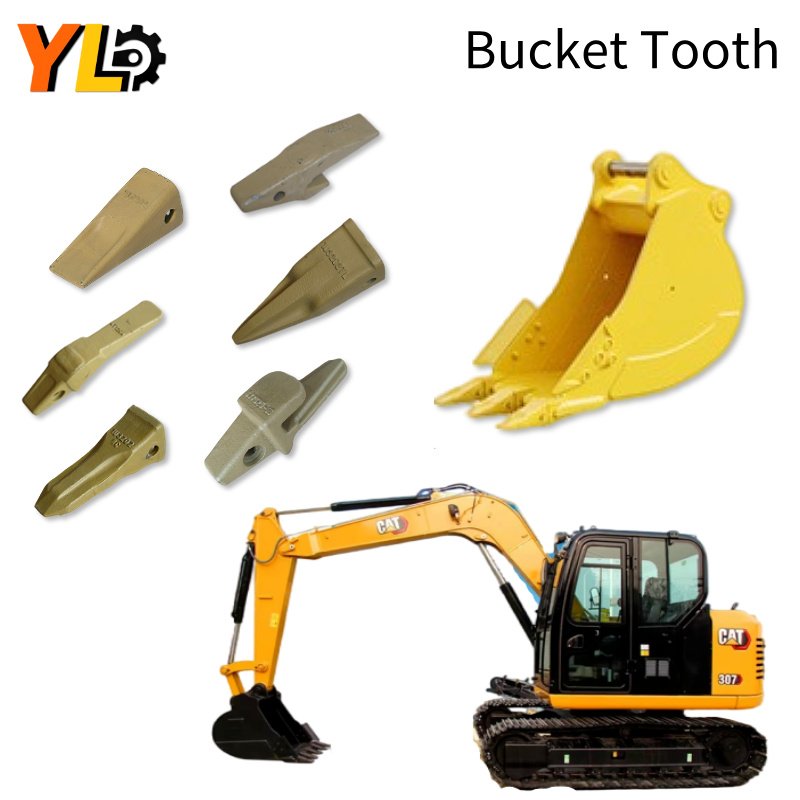
Excavator bucket tooth castings are critical components in earthmoving machinery, designed to withstand extreme wear and impact during excavation. Here’s a comprehensive overview based on the latest industry practices and technological advancements:
Material Selection
- Alloy Steel Dominance:
High-strength alloy steel (e.g., 42CrMo4, 1Cr18Ni9Ti) is the primary material for modern bucket teeth, offering a balance of hardness (48–52 HRC) and impact resistance (≥15 J at 25°C). These alloys are heat-treated to achieve a martensitic structure, enhancing toughness and wear resistance in abrasive environments like mining and construction. - High Manganese Steel (Mn13):
While less common today, Mn13 is still used in high-impact scenarios (e.g., quarrying) due to its work-hardening properties. However, it performs poorly in mixed abrasion-impact conditions, where alloy steel excels. - Emerging Composites:
Some manufacturers are exploring hybrid materials (e.g., carbide-reinforced alloys) for specialized applications, though adoption remains limited to niche markets.
Casting Processes
- Sand Casting:
Widely used for cost-effective production of large or medium-sized teeth. It allows flexibility in design and material selection but offers moderate dimensional accuracy. Recent advancements include resin-bonded sand molds for improved surface finish. - Investment Casting (Lost Wax):
Ideal for complex geometries and tight tolerances, this process produces near-net-shaped parts with minimal post-machining. However, it is more expensive and suited for high-precision applications like marine or mini-excavators. - Shell Casting:
A hybrid method using phenolic resin-coated sand to create thin, reusable molds. It combines the cost-efficiency of sand casting with the precision of investment casting, gaining traction in China for producing wear-resistant teeth. - Forging:
Complementary to casting, forged teeth (e.g., Xiamen Gold Forging’s products) are used in high-stress applications, offering superior grain structure and fatigue resistance.
Performance and Design Innovations
- Self-Sharpening Teeth:
Modern designs (e.g., Caterpillar’s Penetration Plus tips) feature tapered profiles that maintain cutting efficiency as the tooth wears, reducing downtime for replacementsCaterpillar. - Wear Material Optimization:
Systems like BYG’s Futura T2 incorporate raised ribs and recessed pockets to enhance material flow, extending wear life by 20% compared to traditional designs. - Hardness and Impact Resistance:
Industry standards now specify hardness ranges of 470–520 HB (Brinell) or 48–52 HRC, with impact resistance exceeding 15 J, ensuring durability in harsh conditions.
Manufacturing and Quality Control
- Certifications and Testing:
Leading suppliers adhere to ISO 9001:2015 and perform rigorous checks, including ultrasonic testing, hardness measurements, and tensile strength tests (≥1450 MPa). For example, Ningbo Re Fue Machinery guarantees compatibility with OEM specs for Caterpillar, Komatsu, and other major brands. - Surface Treatments:
Zinc plating, hot-dip galvanizing, and shot blasting are common to improve corrosion resistance and reduce friction during excavation.
Market and Suppliers
- Global Market Dynamics:
China dominates production, accounting for over 80% of global exports, followed by Belgium and South Korea. - Cost Considerations:
Prices range from $1.3–1.6/kg for standard alloy steel teeth to $200–1000/piece for premium forged or specialized designs (e.g., mining-specific adapters).
Environmental and Sustainability Trends
- Eco-Friendly Processes:
Shell casting and water-based sand binders are reducing waste and emissions compared to traditional methods. - Regulatory Compliance:
Growing demand for ISO 14001-certified facilities reflects a shift toward sustainable manufacturing practices, though adoption varies by region.
Excavator bucket tooth castings are evolving to meet the demands of higher efficiency and sustainability. Alloy steel remains the material of choice, while casting processes like shell molding are bridging cost and precision gaps. With China as the global production hub, suppliers are increasingly integrating automation and eco-friendly practices. End-users should prioritize material selection based on (e.g., alloy steel for mixed abrasion-impact, Mn13 for high-impact) and partner with certified manufacturers to ensure performance and longevity.