
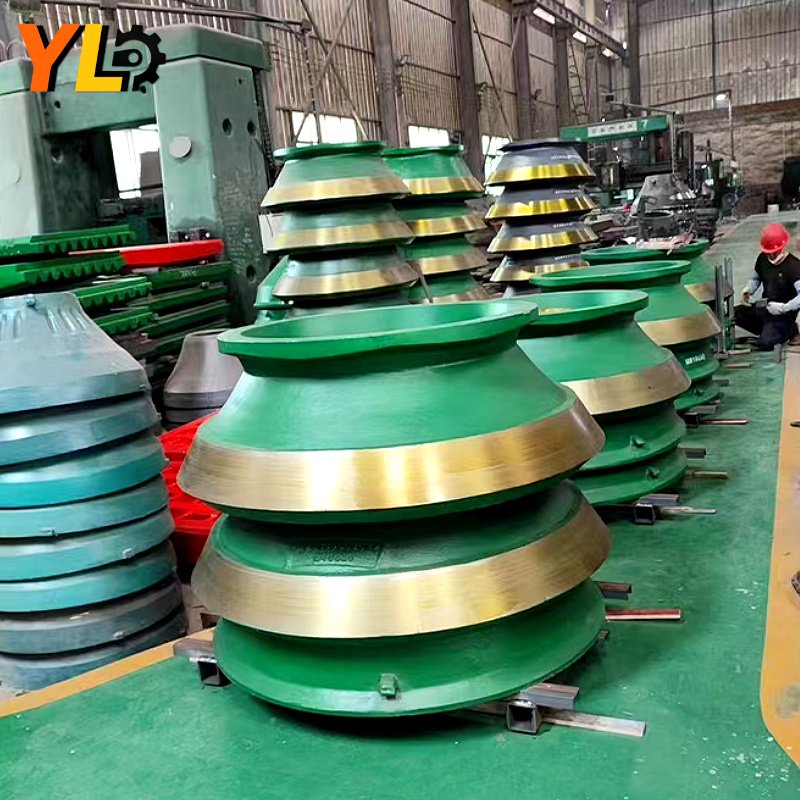
A cone crusher bowl liner (also called a concave liner) works as a critical stationary component that collaborates with the rotating mantle to crush material through compressive force. Its design and interaction with the mantle create a dynamic crushing chamber, enabling efficient reduction of large rocks into smaller, usable particles. Here’s a step-by-step breakdown of how it functions:
1. Forms the Crushing Chamber
The bowl liner is a concave, ring-shaped wear part bolted or wedged into the upper stationary frame (the “bowl”) of the cone crusher. It pairs with the mantle—a convex, cone-shaped component attached to the rotating “spindle” or “gyratory cone” below. Together, the bowl liner (stationary) and mantle (moving) form a tapered, annular space called the crushing chamber.
2. Guides Material Flow
Material (e.g., ore, rock) enters the crusher through the top feed opening and falls into the wide upper section of the crushing chamber, defined by the bowl liner’s upper profile. The liner’s internal geometry—typically a series of tapered, curved ridges or smooth concave surfaces—is engineered to:
- Channel material downward through the chamber.
- Control the rate of flow to ensure even feeding (avoiding “bridging” or blockages).
- Direct material toward the narrower lower section, where final crushing occurs.
3. Enables Compressive Crushing
The mantle rotates eccentrically (off-center) via the crusher’s drive mechanism. As it gyrates, the mantle moves closer to and farther from the bowl liner in a cyclic pattern:
- When the mantle swings toward the bowl liner, the gap between them narrows, squeezing the material trapped in the chamber.
- This compressive force exceeds the material’s tensile strength, causing it to fracture or break into smaller pieces.
- As the mantle swings away, the crushed material falls into the wider gap below, continuing its descent through the chamber.
4. Stages of Crushing
The bowl liner’s tapered design creates distinct zones within the crushing chamber, each contributing to progressive reduction:
- Feed zone (upper section): Wide gap to accept large incoming material. The bowl liner’s profile here guides material into the chamber without jamming.
- Crushing zone (middle section): Narrower gap where most compression occurs. The liner’s curvature ensures material is repeatedly squeezed as the mantle gyrates.
- Discharge zone (lower section): The narrowest gap (set by the “closed side setting,” or CSS). Here, the bowl liner and mantle work together to produce the final particle size, with crushed material exiting through the bottom.
5. Resists Wear
The bowl liner is made from wear-resistant materials (e.g., high manganese steel, high-chrome alloys) that “work-harden” under impact and compression. As material grinds against its surface, the metal’s structure becomes harder, slowing wear and extending the liner’s lifespan. This durability ensures consistent chamber geometry over time, maintaining crushing efficiency.
Key Takeaway
The bowl liner’s role is both structural and functional: it defines the crushing chamber’s shape, guides material through progressive reduction, and withstands extreme forces to enable the mantle’s compressive action. Without a properly designed and maintained bowl liner, the crusher would fail to produce uniform particle sizes, suffer excessive wear, or experience jams.