
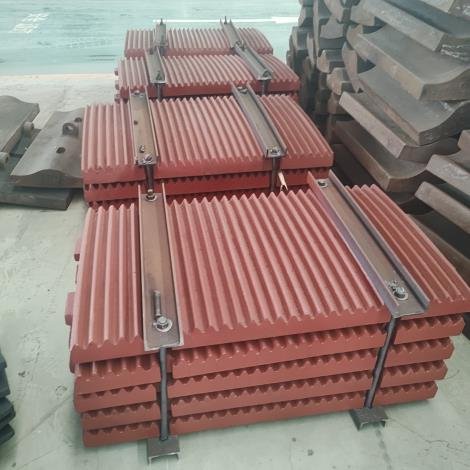
Crusher teeth plate (also known as jaw plate) is the core wear-resistant component of jaw crushers. It consists of a fixed jaw plate (stationary jaw plate) and a movable jaw plate (swing jaw plate), which crush materials through mutual extrusion and shearing.
- Working Principle: Driven by an eccentric shaft, the swing jaw makes reciprocating motions. It generates extrusion and impact when approaching the stationary jaw, and materials fall when moving away, realizing continuous crushing.
- Application Fields: Mining, construction aggregates, metallurgy, road construction, chemical industry and other sectors. It is suitable for crushing hard rocks and ores such as granite, limestone and iron ore.
Material Selection and Characteristics
| Material Type | Typical Grade | Features | Application Scenarios |
|---|---|---|---|
| High Manganese Steel | ZGMn13, Mn18Cr2 | Excellent work hardening performance, low initial hardness (about 180HBW), surface hardness increases to over 500HBW after impact, high toughness | Hard rocks with compressive strength <250MPa, primary crushing in large mines |
| Medium Carbon Low Alloy Steel | – | Balanced hardness and toughness, resistance to fatigue spalling, moderate cost | Medium-hard materials, continuous operation scenarios |
| High Chromium Cast Iron | – | Extremely high hardness, strong wear resistance, low toughness | Highly abrasive materials such as quartz sand and concrete recycling |
| Composite Material | Bimetallic, TiC-embedded | Wear-resistant tooth crown + tough tooth root, service life increased by more than 3 times | Extreme working conditions, pursuing long service life and high efficiency |
| New Materials | Fe10V, “Starry Sky” | Ultra-high hardness of 60-65HRC, good impact toughness, excellent welding performance | High-performance requirements, hard-to-crush materials |
Selection Principles:
- Hard materials (granite, quartz) → High manganese steel / High chromium cast iron
- Soft materials (concrete, limestone) → Medium manganese steel / Ordinary alloy
- Prioritize toughness for movable jaw plates and hardness for stationary jaw plates
Tooth Profile Design and Parameters
Common Tooth Profile Types:
- Wide Tooth (WT): Large spacing, suitable for bulk materials, reducing blockage
- Corrugated Tooth (C/CC): Enhances material gripping, improves crushing efficiency
- Sharp Tooth (ST): Strong penetration, suitable for hard and dense materials
- Heavy-Duty Tooth (HD/UT): Thick tooth body, impact-resistant, suitable for ultra-hard materials
- Super Grip Tooth: Special design, strong grip on round rocks, smooth fine material discharge
- Wolf Tooth / Wolf Claw Tooth: Bionic design, suitable for coarse crushing of coal and ore, high strength
Influence of Key Parameters:
- Tooth Pitch: Larger pitch improves material cracking effect but reduces production capacity; maximum stress occurs at tooth top and root
- Tooth Height: High teeth increase crushing ratio but reduce strength; low teeth improve strength but decrease material biting force
- Tooth Tip Fillet: Reduces stress concentration, prolongs service life
Manufacturing Process and Technology
Mainstream Processes:
- Sand Casting: Traditional method, moderate cost, suitable for large-scale tooth plates, general precision
- Lost Foam Casting: No parting surface, high precision, reduced machining allowance, suitable for complex tooth profiles
- Bimetallic Composite Casting: Wear-resistant tooth crown + tough tooth root, optimal comprehensive performance, service life increased by 2-3 times
- Overlay Welding / Thermal Spraying: Surface strengthening of tooth crown, repairing old tooth plates or improving wear resistance of new products
- 3D Printing: Emerging technology, micro-density up to 99.2%, suitable for complex shapes and small-batch customization
Maintenance and Replacement
Service Life Cycle:
- Standard working conditions: Inspection or replacement required after 400-500 hours
- Hard rock crushing: Service life shortened by 30-50%
- High-quality materials: Service life can be extended by 50-100%, and composite materials can reach more than 3 times that of ordinary materials
Replacement Steps:
- Shut down the machine and cut off the power supply, hang warning signs
- Remove the fixing bolts and take out the old tooth plate (use a crowbar if necessary)
- Clean the mounting surface and check the fitting precision
- Install the new tooth plate (pay attention to the direction) and fasten the bolts evenly
- Ensure no looseness before starting, and conduct no-load test run
Tips for Extending Service Life:
- Ensure tight fit during installation; use plastic materials on the contact surface to increase sealing
- Conduct regular inspections and timely adjust or flip for use (most tooth plates are bidirectional designed)
- Feed materials evenly to avoid local wear caused by unbalanced load
Market and Technology Trends
- Market Scale: China’s annual production capacity is about 1.28 million tons, with an annual growth rate of 5.6%. High manganese steel tooth plates account for 45% of the market.
- Price Range: Ordinary high manganese steel: 1.4-2.2 USD/kg; high-quality composite materials: more than 3 USD/kg
- Technology Frontiers:
- Intelligent Tooth Plates: Integrated sensors for real-time wear monitoring and service life prediction
- Adaptive Design: Tooth profile parameters change along the length of the tooth plate to optimize overall stress distribution
- Nano-material Reinforcement: Ceramic particle composite, wear resistance increased by 3-5 times
Selection Guide
- Based on Material Characteristics:
- Hardness <200MPa: Mn13Cr2 (18% manganese steel)
- Hardness 200-300MPa: Mn18Cr2 (20-24% high manganese steel)
- Highly abrasive materials: TiC-embedded or bimetallic composite
- Based on Equipment Type:
- Large jaw crushers (>600mm): Heavy-duty teeth + ultra-high manganese steel
- Medium jaw crushers: Standard teeth + medium manganese steel
- Small jaw crushers / Mobile crushers: Lightweight design, balancing efficiency and cost
As a core wearing part, the material, tooth profile and manufacturing process of crusher teeth plates directly determine equipment efficiency and operating costs. Selection should comprehensively consider material characteristics, working conditions and economy. Prioritize cost-effective composite materials or improved high manganese steel to balance service life and initial investment.