
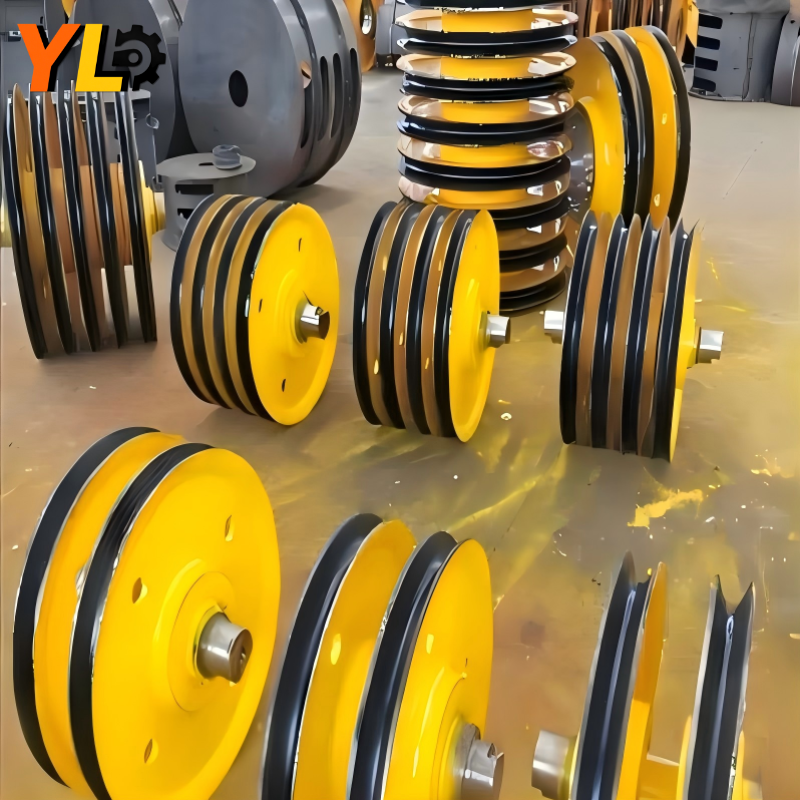
1. Core Design Features
- Precision Groove Matching
- Profile Design: V or U-shaped groove with curvature radius = rope diameter × (5.5–6) to prevent stress concentration and rope deformation.
- Surface Hardness: ≥55 HRC (quenched) to minimize wear rate (<0.1mm/1,000 cycles).
- Bearing System
- Heavy-Duty Solution: Double-row tapered roller bearings (40% higher load capacity vs. deep groove ball bearings).
- Sealing Technology: IP66 rating for dust/water resistance, grease service life >10,000 hours.
- Safety Redundancy
- Breakage Factor: ≥5:1 (per DIN 15020), ultimate load = nominal load × 5.
- Anti-Derailment: Sidewall height ≥1.5× rope diameter, with nylon flanges (150J impact resistance).
2. Materials & Manufacturing
| Component | Material | Process | Advantage |
|---|---|---|---|
| Sheave Body | 42CrMo alloy steel | Die forging + quenching | Tensile strength ≥1080 MPa |
| Bearing Hub | QT500-7 ductile iron | Sand casting + shot peening | 30% higher vibration damping |
| Groove Surface | High-chromium iron (Cr15Mo3) | Centrifugal casting + laser cladding | 4× wear life extension |
3. Key Performance Metrics
- Dynamic Fatigue Life
- Test Standard: ISO 5049 cyclic loading (10^6 cycles at 1.25×SWL).
- Pass Criteria: No cracks, groove deformation ≤0.5% of sheave diameter (D).
- Efficiency & Loss
- Transmission Efficiency: ≥98% (including bearing friction loss).
- Temperature Control: ≤40°C rise under full load (ambient +40°C max).
4. Industry-Specific Applications
| Application | Design Focus | Certification |
|---|---|---|
| Port Cranes | Salt-spray resistance (Zn coating ≥80μm) | FEM 1.001 / ISO 4308 |
| Mine Hoists | Explosion-proof (Ex d IIC T4), IK10 impact rating | EN 1493 / MSHA |
| Wind Turbine Vessels | -50°C cryogenic steel, hydraulic self-aligning system | DNVGL-ST-0378 |
5. Failure Modes & Prevention
- Common Failures
- Groove Collapse: Overload-induced plastic deformation (monitor load ≤90% SWL).
- Bearing Seizure: Lubricant contamination or axial overload (grease inspection every 500 hrs).
- Maintenance Strategy
- Wear Limit: Replace if groove diameter increases >5% or crack depth >2mm.
- NDT: Ultrasonic testing every 6 months (focus on hub stress zones).
6. Technology Trends
- Lightweighting: Carbon fiber composite sheaves (50% weight reduction, ≥85% strength retention).
- Smart Monitoring: Embedded strain sensors + LoRa wireless telemetry for real-time overload alerts.
- Remanufacturing: Laser-repaired grooves reduce replacement costs by 60%.