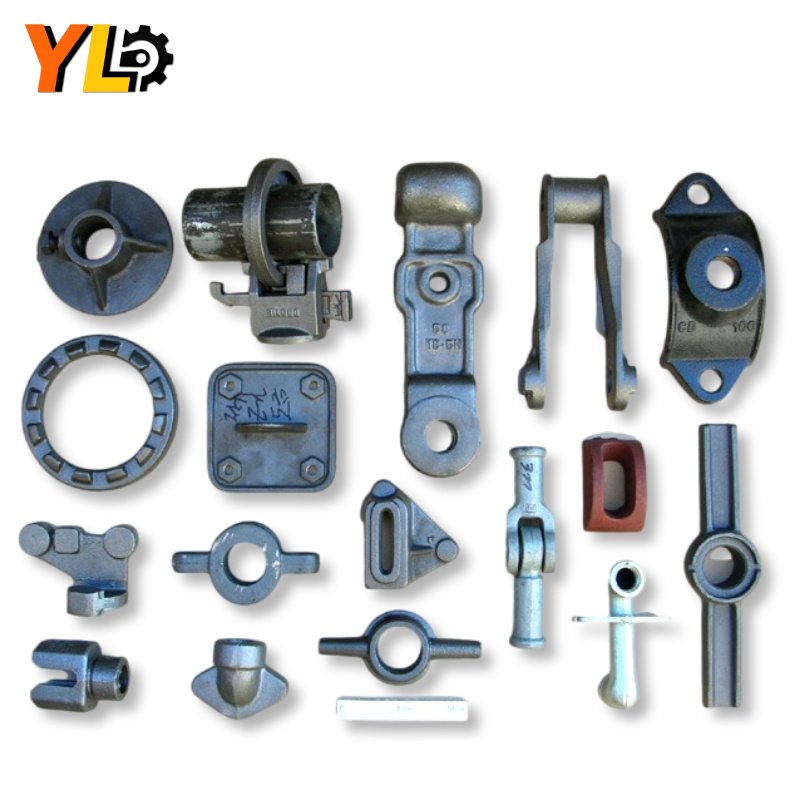
The core of the casting process for ductile iron castings lies in converting qualified molten iron into castings that meet mechanical property requirements through mold preparation, precise pouring, and solidification control, based on spheroidization and inoculation treatment. Its key focus is to address molding quality and internal defect issues.
This process not only inherits the convenience of cast iron casting but also compensates for the brittleness of traditional cast iron through spheroidization treatment, making it a crucial technology for mass production of complex load-bearing components.
1. Core Casting Process
The casting of ductile iron castings involves 5 key steps, and each step requires specialized control tailored to the material properties of ductile iron.
- Mold Preparation: Select the mold type (e.g., sand mold, metal mold) based on the casting structure and production volume. Sand molds must have sufficient air permeability and strength to prevent porosity defects caused by gases generated during the spheroidization reaction.
- Secondary Treatment of Molten Iron: Before pouring, recheck the temperature of the molten iron that has undergone spheroidization and inoculation (usually maintained at 1380-1450℃). Conduct component fine-tuning if necessary to ensure the molten iron remains in a stable state.
- Pouring Operation: Adopt bottom pouring or step-by-step pouring methods, and control the pouring speed (generally 2-5kg/s) to avoid splashing of molten iron or air entrainment, thereby reducing oxidized inclusions.
- Solidification Control: Arrange risers (usually blind risers) according to the casting wall thickness. For thick and large parts, use slow cooling measures (e.g., covering with thermal insulation materials) to prevent shrinkage cavities and porosity defects.
- Cleaning and Post-Treatment: After the casting cools to room temperature, remove the risers and gates, clean the surface sand, and perform shot blasting if necessary. Critical components require annealing or normalizing to eliminate internal stress and optimize the microstructure.
2. Comparison of Mainstream Casting Methods
Different casting methods are suitable for ductile iron castings of different production volumes and structures, with specific differences as shown in the table below:
| Casting Method | Core Features | Applicable Scenarios |
|---|---|---|
| Sand Casting | Low cost, flexible process, capable of producing complex structural castings | Small-to-medium batch production, large complex components (e.g., machine tool beds, valve bodies) |
| Metal Mold Casting | High dimensional accuracy of castings, smooth surface, high production efficiency | Mass-produced standardized components (e.g., automotive crankshafts, camshafts) |
| Lost Foam Casting | No parting surface, no risers (or simplified risers), no flash on castings | Complex-shaped components that are difficult to demold (e.g., complex pipe fittings) |
| Centrifugal Casting | Dense casting structure, uniform mechanical properties, good wall thickness consistency | Tubular or cylindrical components (e.g., ductile iron pipes, bearing rings) |
3. Key Quality Control Points
During production, focus on preventing and controlling 3 common types of defects, and improve casting qualification rates through process optimization:
- Porosity Defects: Control mold moisture content (≤5%), add vent holes, and strictly control sulfur content (≤0.02%) during spheroidization to reduce gas generation.
- Shrinkage Cavities and Porosity: Arrange risers reasonably according to the hot spot positions of the casting, adopt the principle of sequential solidification, and place chills on thick and large parts to accelerate local cooling.
- Spheroidization Decay: Shorten the interval between spheroidization treatment and pouring (≤15 minutes) to avoid poor graphite sphere morphology caused by prolonged retention of molten iron, which would impair mechanical properties.